Two decades directing creative work: my own studios and forty-four clients, a self-published photography book, commercial video. Then I started designing AI products and shipping them. That combination is the whole pitch: the idea, the craft that renders it, and the build — without a handoff in the middle where the intent gets lost.
Case study 01 · Campaign · Identity · Art direction
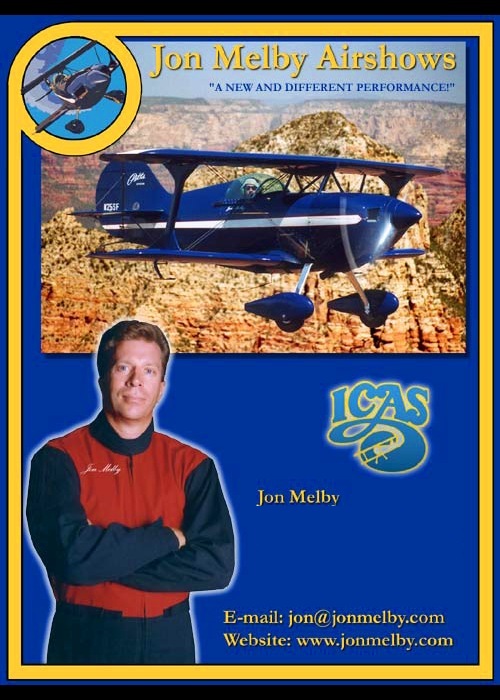
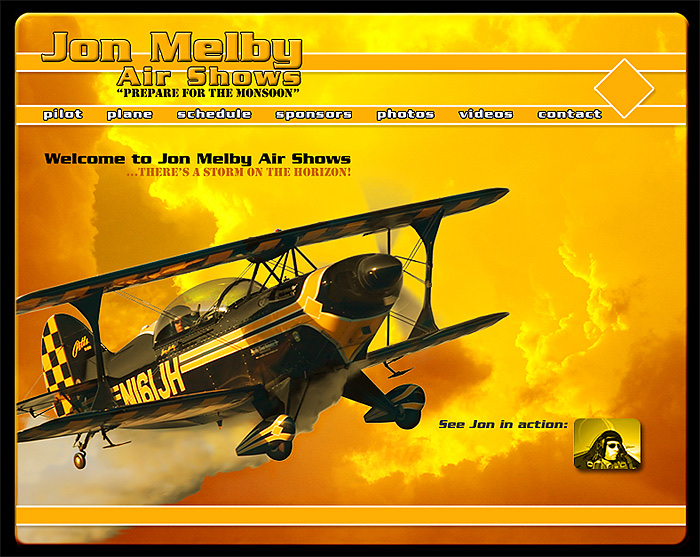
An air-show pilot in his first two seasons, with no marketing and no budget, against a field of corporate teams. I was the entire department — identity, photography, video, print, booth, collateral and the website.
It placed 2nd and 3rd in consecutive years in the International Council of Air Shows (ICAS) Marketing Competition,
the air-show industry's marketing award. The field included the marketing departments of
Red Bull, Oracle and the major oil companies — every one of them sponsors a pilot.
I was in the bathroom when the first award was announced.
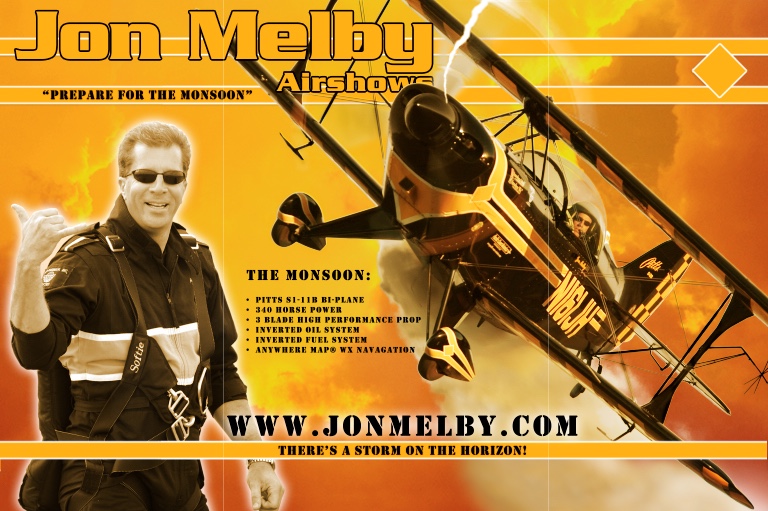
The brand is the plane — and I named it. The name came out of working on the lead photograph. I'd shot Jon's Pitts against a plain blue sky, but it needed more. I pulled a monsoon cloud from my library and began a composite. Putting them together made something neither frame was on its own: the black-and-yellow aircraft breaking out of a storm. The identity was born in that composite, and the name came out of it. I called it The Monsoon — and everything after fell out of the word. The palette was already on the aircraft. The weather was already in the frame. Every surface after that inherited the storm. "There's a storm on the horizon."
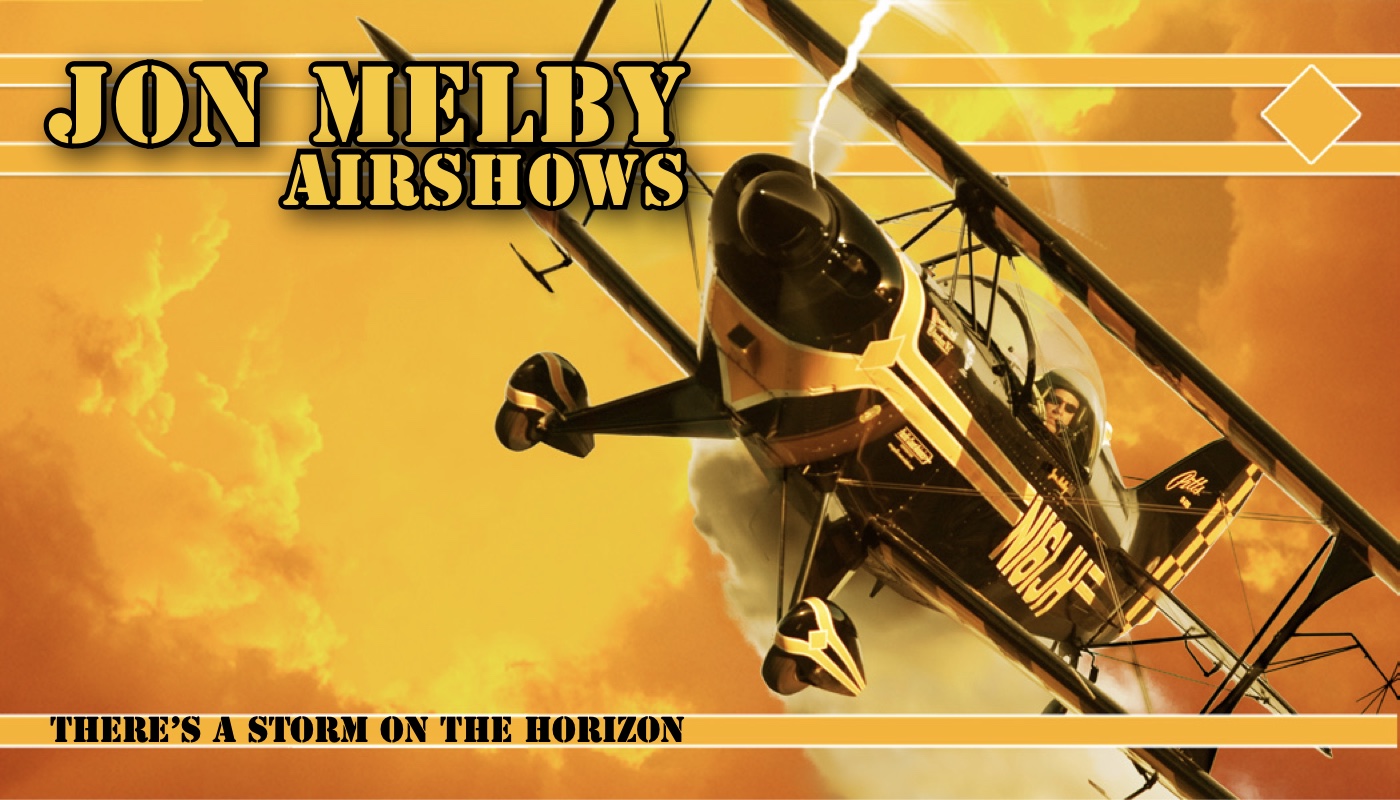
One person across every surface produces a coherence a committee structurally can't. Red Bull's identity passed through brand guardians, agency partners and sign-off chains. This one passed through me at every touchpoint, so nothing drifted. The shoestring didn't win despite being one person — it won partly because of it.
And it kept working. The awards came in the first two seasons; the relationship ran nearly five years, across three aircraft — a Pitts S1, an S2 and an S1B. Winning something once is a good year. Being kept on for five is the harder credential.
And Melby was one of five. Ed Hamill, Eric Beard, Jim Maroney and Rhett Thompson flew with my work on them too, along with the Copperstate Fly-In. For a stretch I was the marketing shop for the air-show circuit — which is a category, not a client. The Monsoon is the one I show because it is the one that was scored.
The first campaign isn't the one above. I was starting out, and Jon was art-directing the work himself —
which is what most small clients do, and it is the single most common way good work doesn't happen.
I was still doing all of it: photography, web, print, graphics, layout, video.
I built what he asked for.
Then a new aircraft arrived and the materials had to be redone.
I delivered exactly what he directed — and then pitched what I would have done instead.
That was the Monsoon: name the
aircraft, then let the weather that came with the name carry everything. I showed him on a
laptop in an Einstein Bagels. He liked it and changed direction.
Every award, every surface and every year that followed came out of a pitch nobody asked for.
That's the part worth hiring. Having the better idea is common. Delivering the brief you were given, on time, and then making the case for the one you believe in — without making the client wrong — is how creative direction actually gets earned. You don't win the argument. You make the other option irresistible and let them choose it.



Case study 02 · Brand extension · Art direction · Photography
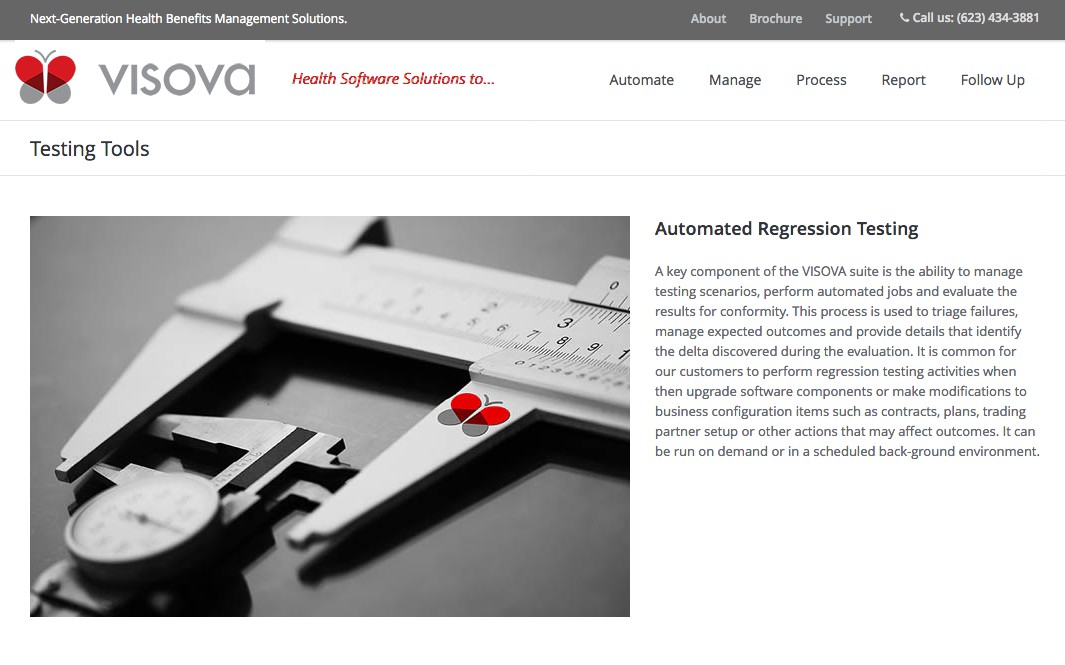
A health benefits software platform — claims, enrolment, compliance, routing. Enterprise software for an industry that mostly looks like a spreadsheet. They already had a mark. What they didn't have was a way to look like anything.
I built the expression system around it: one idea, executed across the entire product line. It ran on their site for ten years.
The mark goes inside the instrument — and the instrument names the product.
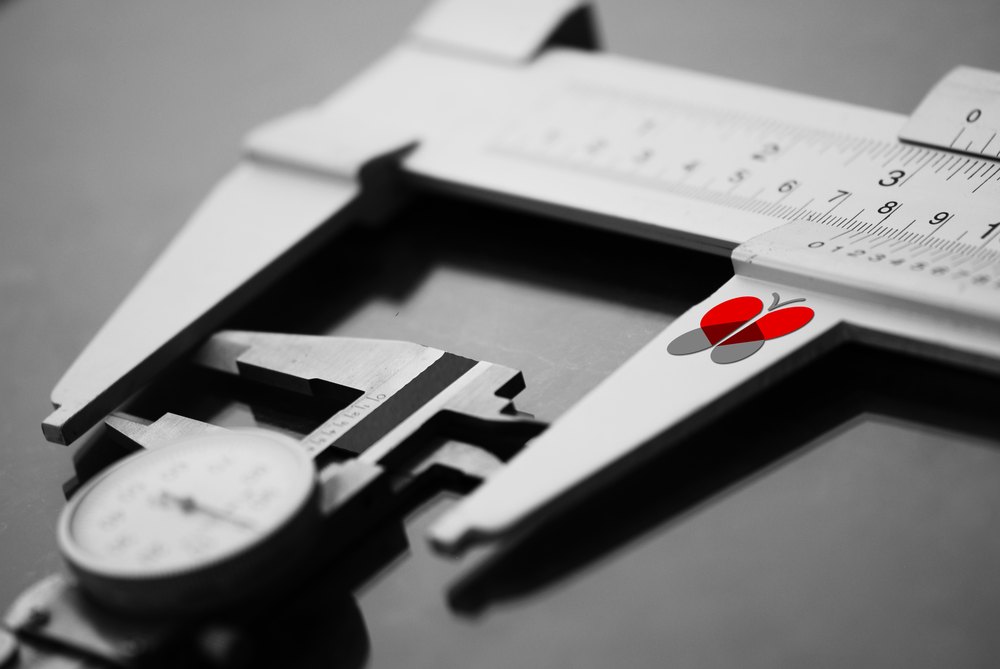
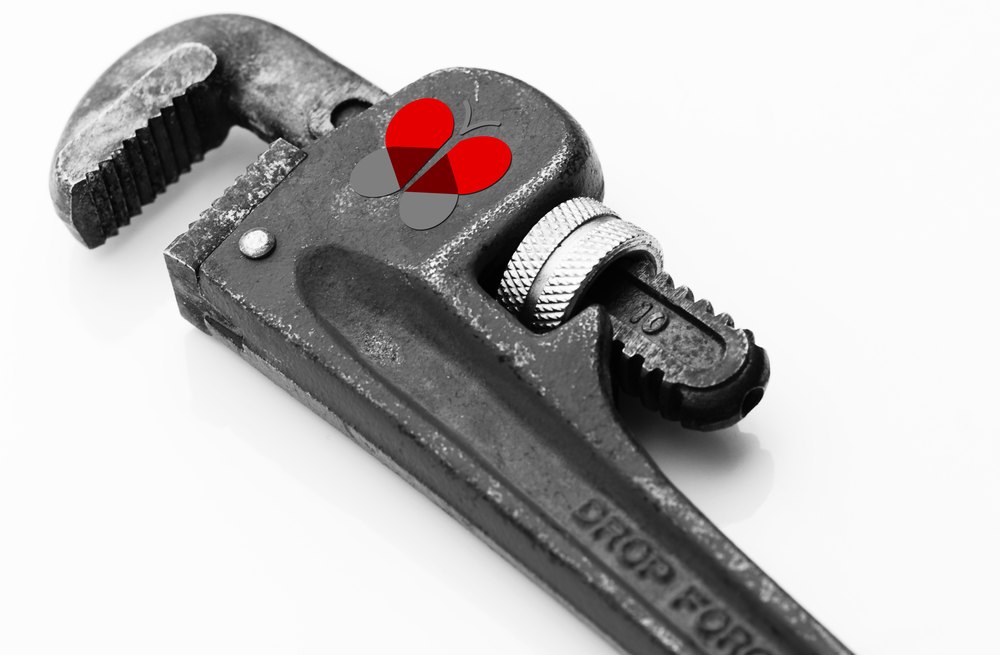
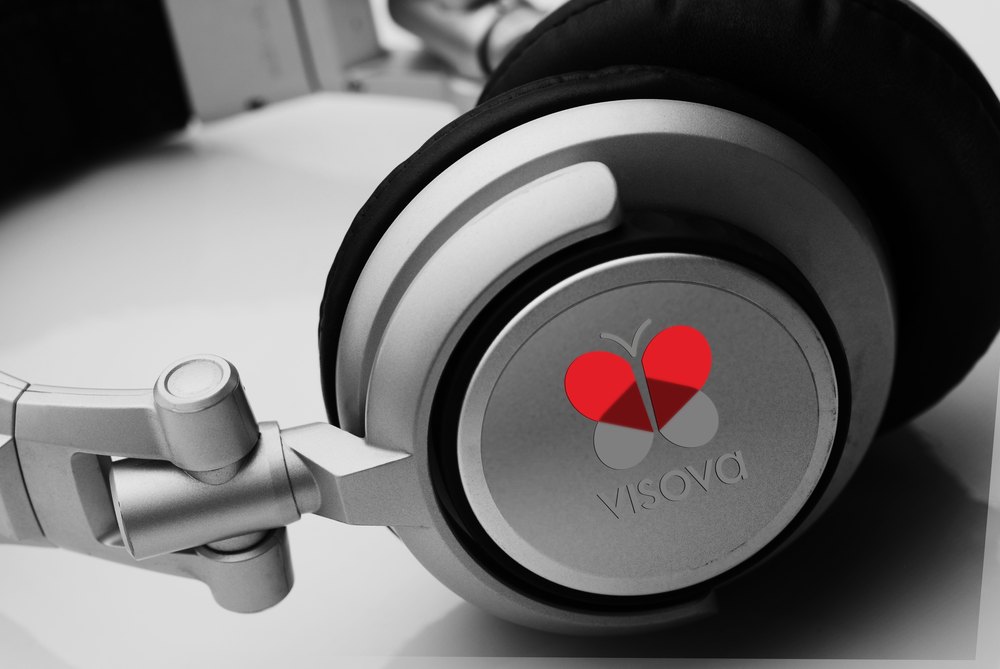
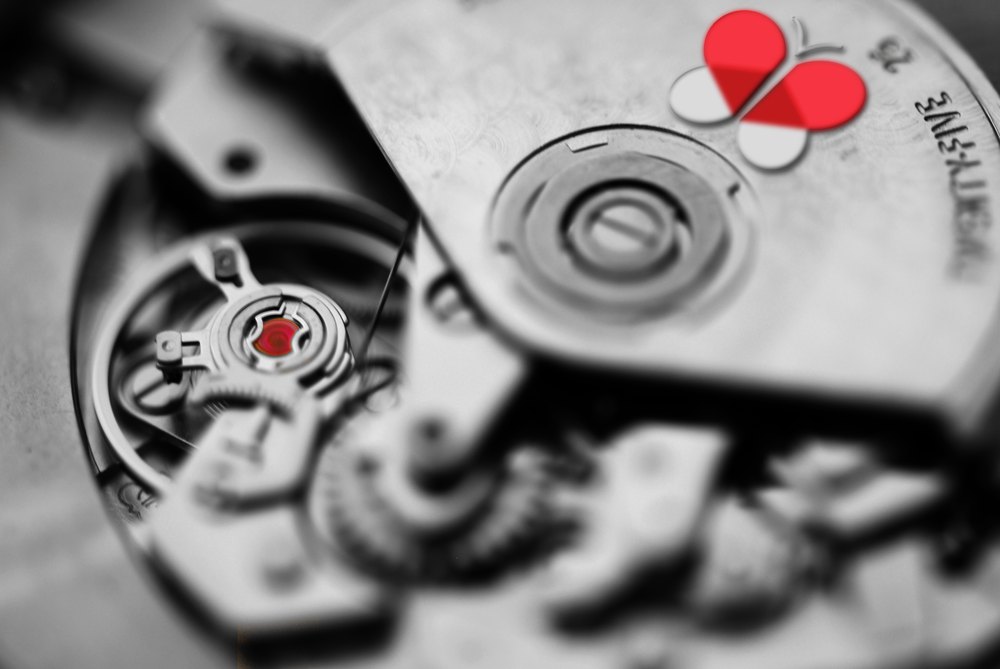
Every frame is the same recipe: a precision tool, shot close, high-contrast black and white,
with the client's mark as the only color in the picture. Never laid on top of the shot.
Sited where the object's own logic already puts something — the jewel in a watch movement,
the membrane in a stethoscope, one key on a keyboard.
Then the tool does a second job. Calipers measure, so the calipers are Testing Tools.
A wrench secures, so the wrench is Security and Compliance. Headphones listen, so the
headphones are Customer Service. Ten product pages, each with its own instrument.
One picture tells you it's Visova, and which part of Visova you're standing in.


Craft · Aerial cinematography · Creative direction
Drone footage from Utah, Wyoming and Montana, flown and directed for Lenticulus. Flying that low is harder than flying high, and it is the reason the rock reads with any scale at all. No client and no brief: it is here because the same person chose the light, put the aircraft in it, and decided what the sequence was about.
Case study 03 · Concept · Art direction · AI direction
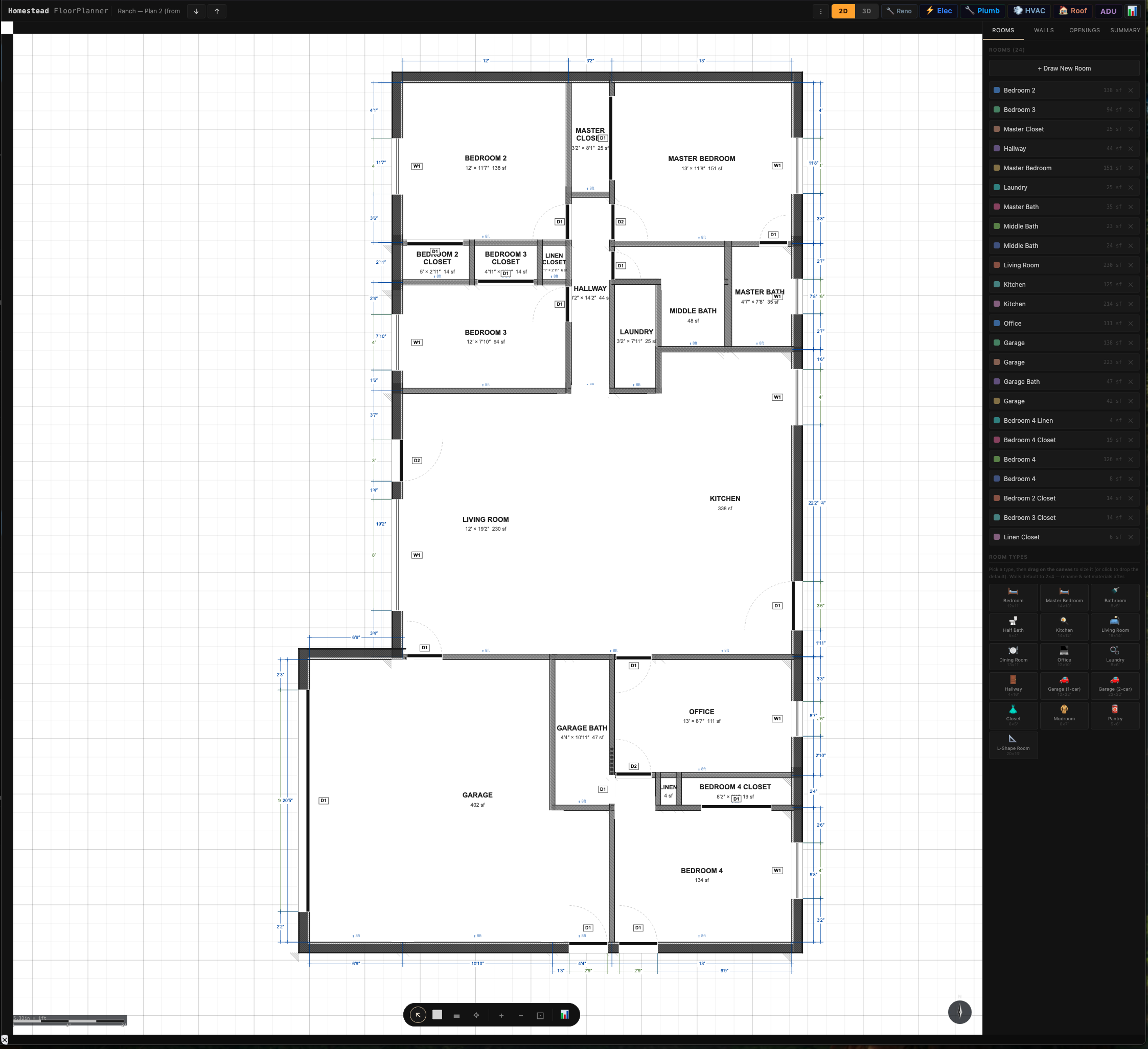
A browser-based suite for designing and running a home renovation — floor plans, site and landscape, and a live cost center — tying design → cost → permits in one place. I built it to run the renovation on my own 1962 Phoenix ranch.
It has to be two products at once: a fluid design tool for exploring, and a precise deliverable a contractor or a permit office will accept. Those want opposite things. A generic build blurs them into one mediocre middle. Keeping them cleanly apart was the whole design problem.
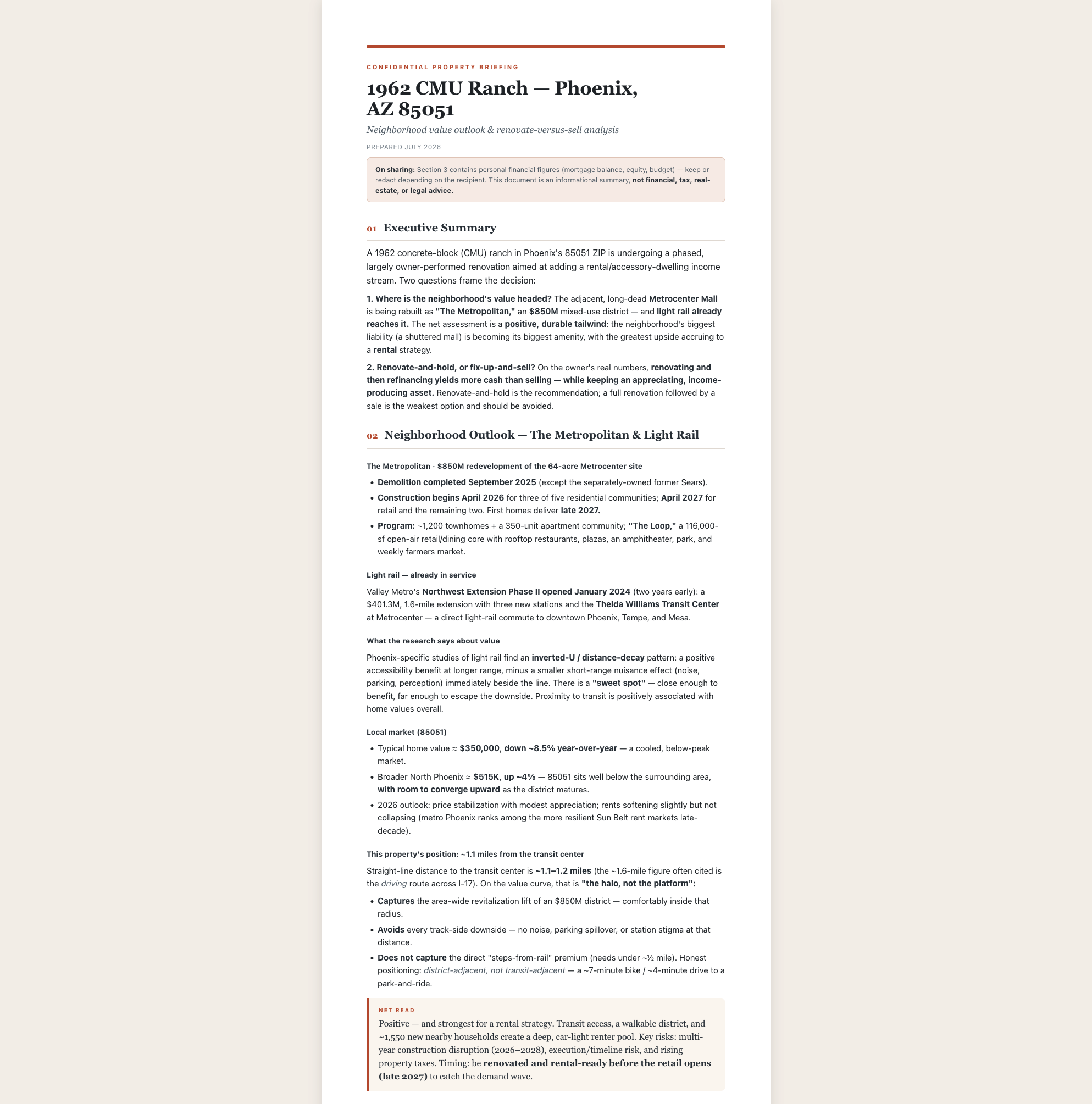
One product, two design languages. White print is the deliverable — Georgia headlines, a terracotta accent system, callouts that carry the argument. The tool is the other context: a dark interface, #080c10 with a single blue accent, wrapped around a light drawing surface — the chrome recedes so nothing competes with the plan. Serving both audiences means designing two deliberate contexts, not one stretched compromise. The deliverable is a separate render pass, never a screenshot of the tool.
Put those two side by side and the argument needs no caption. Same data, two audiences, and neither one is a compromise toward the other.
See the full evidence pack →The range, and what it was for
A boutique ad agency, where the layer I loved was always conceptual direction — the idea that drives the execution. Portraiture, weddings, editorial and commercial photography, long enough to self-publish a coffee-table book: the photography, the marketing, the print production and the writing, all mine. That eye moved into video, and a Part 107 with it. Half a dozen businesses built and run along the way.
None of that is here to say look how many things I can do. Breadth on its own is a warning sign and I'd read it that way too. It earns its place here for one reason: every one of those disciplines is the same question asked in a different medium — is this any good, and how do you know?
Twenty years of asking it. That's the faculty AI hasn't touched. It will hand you a thousand options and hold no opinion about which one is right, and the person who can answer that is doing the only part of the work that didn't just get cheap.
Twenty years, narrated — The Path →Case study 04 · Product design · The spear
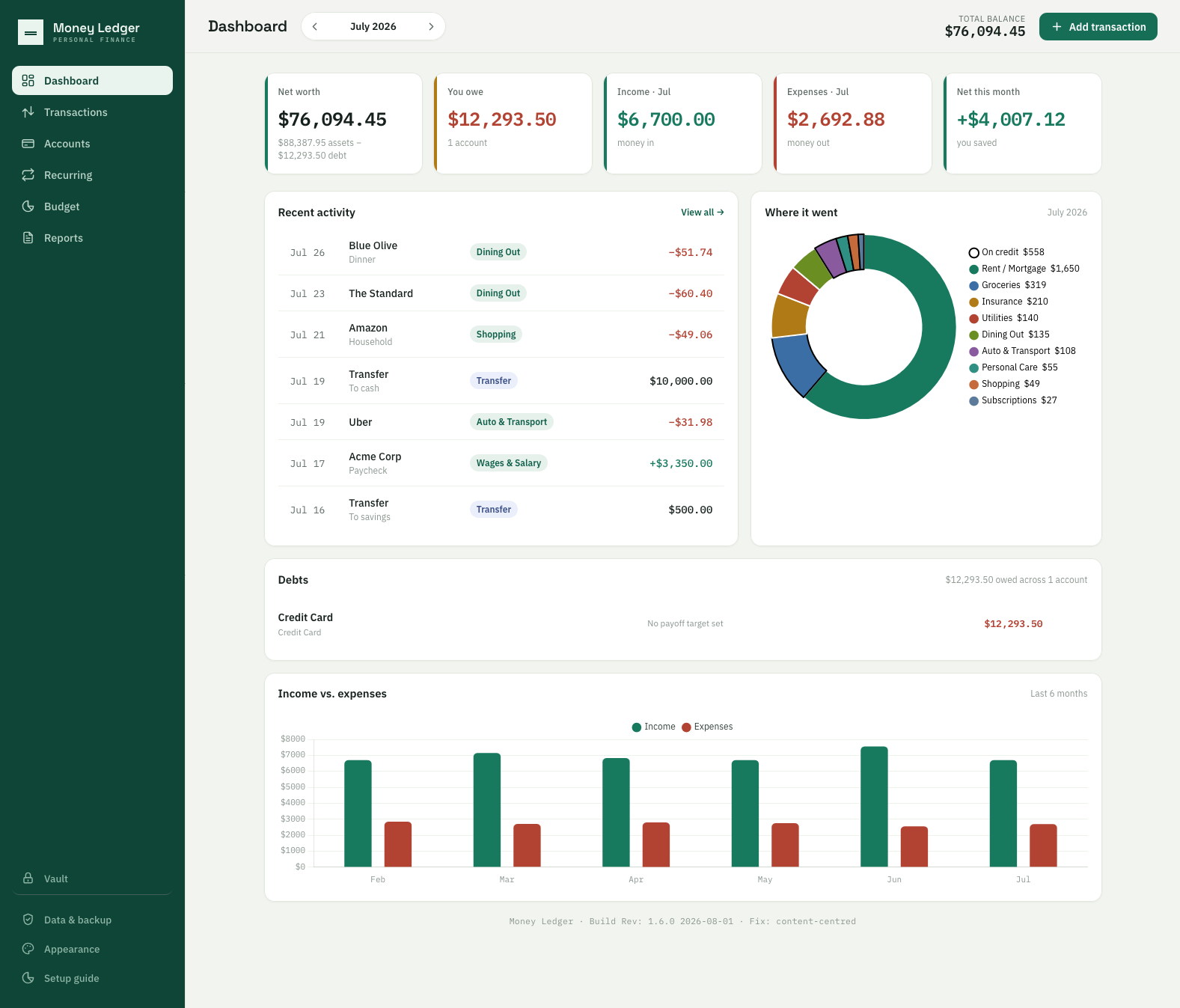
A private, offline personal-finance ledger in a single HTML file — no cloud, no account, no network. I run my own money on it. It's here because taste without shipping ability is a mood board.
Never write after a failed read. Bad state triggers snapshot recovery, or the app refuses all writes rather than overwrite a corrupt record. For a finance app, silent data loss is unforgivable — so the persistence layer is designed around protecting the record, not around the happy path. Decide what the product can never do to the user, then build backward.
Why this matters more than the screenshots
Assembling the evidence on this page should have been a screenshot session. Both times it became an audit, because I read the output and didn't believe it.
A permit document counting a garage as conditioned living space. Every expense in a ledger signed + — money leaving, marked as money arriving. A debt goal reading “$12,293.50 of $1,500.00 — 0%”: two true numbers arranged into arithmetic that can't be right.
Not one of those could fail a test, because not one of them was a calculation. A test cannot know that “conditioned space” excludes a garage, or that a plus sign on a debit is a lie. That takes somebody who knows the domain, reads the result, and refuses it.
The fear nobody says out loud about AI creative is slop — infinite volume with nobody judging it. Judging it is the job I've been paid for since 2019.
See the working method →The part that happened at work
Everything above this line I built at my own desk. These I built inside Intel's validation labs, on the clock, for people who are still using them. Same instinct, seven years, and a job title that says technician.
Stop before you do something irreversible. The drive cleaner finds what it found, shows you, and asks before it wipes. The bringup script asks separately about kernels, because a test system pinned to a specific build is destroyed by the update any sane default would have run. Neither is a technical nicety — both are somebody deciding what this tool must never do to the person using it, then building backward from that. It's the same call I made years later when a finance app of mine turned out to delete records silently.
In 2021 the lab held over a thousand pieces of pre-production silicon across several labs and no way to find any of it — locating one part meant a thirty-minute hand search. I was tired of losing the half hour, so I designed the coding scheme and built the database. It's still what the lab uses.
The four since are the same move. A script that reclaims USB drives which Linux installs have left unreadable — the reason it matters isn't the drives, it's that engineers were interrupting their own work, and each other's, hunting for one that worked. A bringup script that takes a fresh machine from unusable to working, since a new system can't update at all until the corporate proxy configuration is in place and that was being typed by hand every time. A Windows utility that discovers the active COM ports and maps them for serial capture, because the machine already knows which ports are live and making a person retype that is the actual defect. And a PowerShell tool that updates KVM and PDU firmware across the lab and logs what it did, so somebody can audit it afterwards.
I wrote these; AI compressed the work. That's a different claim from the products above, where I set the principles and directed the build against them — and the difference is worth stating rather than blurring. What AI changed here was how fast a noticed problem becomes a shipped fix. It didn't do the noticing.
It's also on the other side of the job, and that side is the one worth hiring. I use AI to troubleshoot systems, and it's wrong often — which isn't a complaint. A wrong answer isn't a failure of the tool; it's a hypothesis. Root cause analysis is the business of killing hypotheses until one survives, and AI generates them faster than I can. That's exactly what I want from it.
A remote desktop service stopped working after a routine point release. The model kept returning to the same fix — switch off the security layer — because that is the answer the internet has for those symptoms. It was wrong, and it was wrong in a way worth understanding: the fault was newer than anything the model had read, so it reached for the most common answer rather than the right one. A model with nothing to draw on doesn't say “I don't know.” It says the most common thing. Knowing that's how it fails is worth more than catching any single wrong answer — and you don't disable a security control to make a service start.
The system behind all of it
Everything on this page that involved AI — the products, the interfaces, the copy under pressure — came out of 447 hours across 303 sessions, and at that volume the thing that breaks isn't the model. It's drift. So the way I work became a product of its own: a written operating contract, ten workflows that open and close every session the same way, and 91 automated guards that test the method rather than the output. Two have gone red and were closed the same day, and the page keeps the count visible.
Creative direction and validation turn out to be the same muscle — deciding whether work that looks fine actually is. That is the argument in full on its own page.
The combination is the moat
I'm a creative director with a product designer's hands. Two decades of concept work — a boutique ad agency, a self-published photography book, commercial video, half a dozen businesses I built and ran — taught me to know good when I see it. Since 2019 I've also been at Intel, validating silicon and server hardware: paid to decide whether something is good enough before a customer ever sees it.
Those felt like two careers until I noticed I keep doing the same thing in both — the lab tools above, a finance app I now run my own money on, a renovation suite for my own house. See the missing tool, build the missing tool. AI made that faster. It didn't change the other half of the job, which is refusing an answer that looks fine and isn't.
Twenty years, narrated — The Path →Same work, different order — that door opens on the product decisions. Otherwise: I'm looking for a remote role directing AI creative or AI product work, somewhere the taste and the rigour both get used.
Get in touch Product design door →